Kibbe body types are often introduced through dramatic before-and-after photos, quizzes, and arguments about celebrity typing. That is the noisy version. The more useful version is a way of noticing how line, scale, shape, and detail interact on one person. It does not measure worth, size, or how closely someone resembles a list of examples. It offers a vocabulary for why a beautifully made garment can still feel slightly off.
What the Kibbe system is actually observing
David Kibbe's image identity system considers an overall physical impression rather than separating the body into a checklist of flaws to correct. The familiar yin and yang language describes visual qualities: yin tends toward softness, roundness, and delicacy; yang toward length, angularity, and sharpness. Most people show a mix. The point is not to score each feature as good or bad, but to notice which qualities dominate when the whole person is seen together.
Why an online Kibbe test can create more confusion than clarity
A typical Kibbe test asks about shoulders, hands, eyes, lips, height, and many other features. It can be a useful prompt for observation, but it is not a diagnosis. Multiple-choice answers flatten three-dimensional traits, and photographs distort proportions through camera angle, posture, lens choice, and pose. A selfie taken from below can make a face look broader; a mirror photo with one hip tipped out can change the apparent line of the torso.
Online communities also preserve older terminology and home-made subtypes that do not always match the current system. This is where beginners get stuck: one quiz returns Soft Natural, a mood board suggests Theatrical Romantic, and a friend says the person looks Classic. None of those labels has to become an emergency. Start with what repeats across real outfits instead.
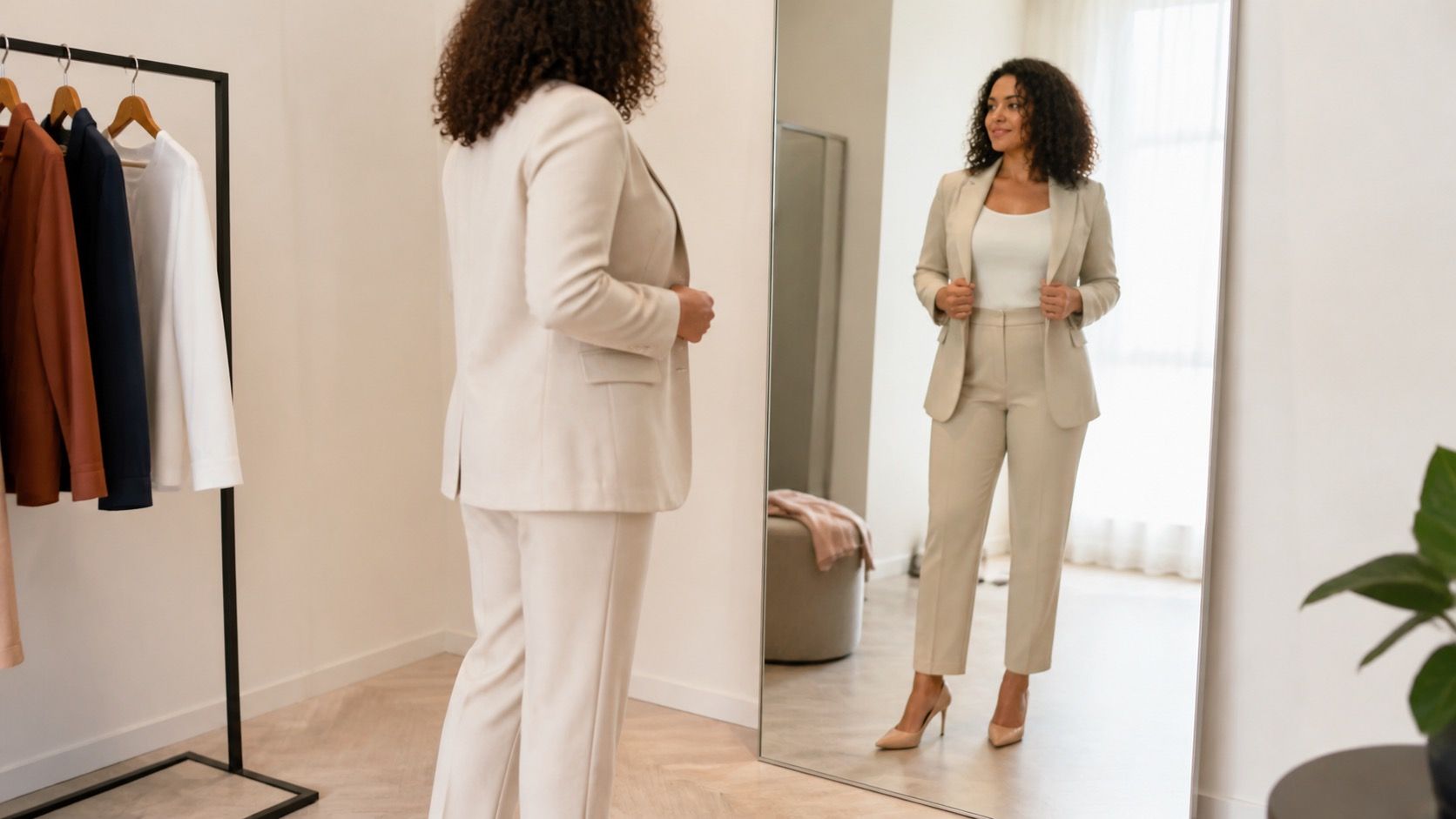
Use images taken at a comfortable distance, in simple fitted clothing, with neutral posture. Then compare how several garment shapes behave. A long straight coat, a softly draped dress, a cropped jacket, and a relaxed shirt each reveal something. The most useful evidence comes from repeated reactions to clothes, not from one disputed feature.
Use line, scale, and accommodation to read clothing
Accommodation is the practical heart of Kibbe image identity. It asks what a garment needs to make room for: vertical length, curve, width, balance, or a compact combination of features. It does not mean hiding anything. A person who accommodates vertical may need uninterrupted length in a coat or trouser; someone who accommodates curve may need shaped fabric that follows the body instead of flattening it.
| What you notice | Question to test | Clothing experiment |
|---|---|---|
| Vertical | Do long, unbroken shapes look calmer? | Try a long coat and matching trousers |
| Curve | Does rigid fabric fight the body? | Compare shaped drape with a boxy shirt |
| Width | Do tight shoulders feel restrictive or look compressed? | Try relaxed shoulders with clear structure |
| Balance | Do extremes overpower the overall effect? | Test moderate scale and symmetrical shapes |
Scale is equally important. Large, bold prints can look natural on one person and crowded on another, even at the same height. Tiny jewelry may disappear on a person with a stronger frame, while oversized hardware can take over a smaller, more delicate appearance. Try the same outfit with different earring sizes, belt widths, and bag shapes. These are low-stakes tests with clear results.
Line does not require a monochrome wardrobe or a perfectly tailored silhouette. It can come from the cut of a sleeve, the width of a lapel, the length of a hem, or the way a print follows the garment. Watch where the eye pauses. If every seam, accessory, and contrast asks for attention, the outfit may be competing with the person rather than supporting them.
Turn recommendations into wardrobe experiments
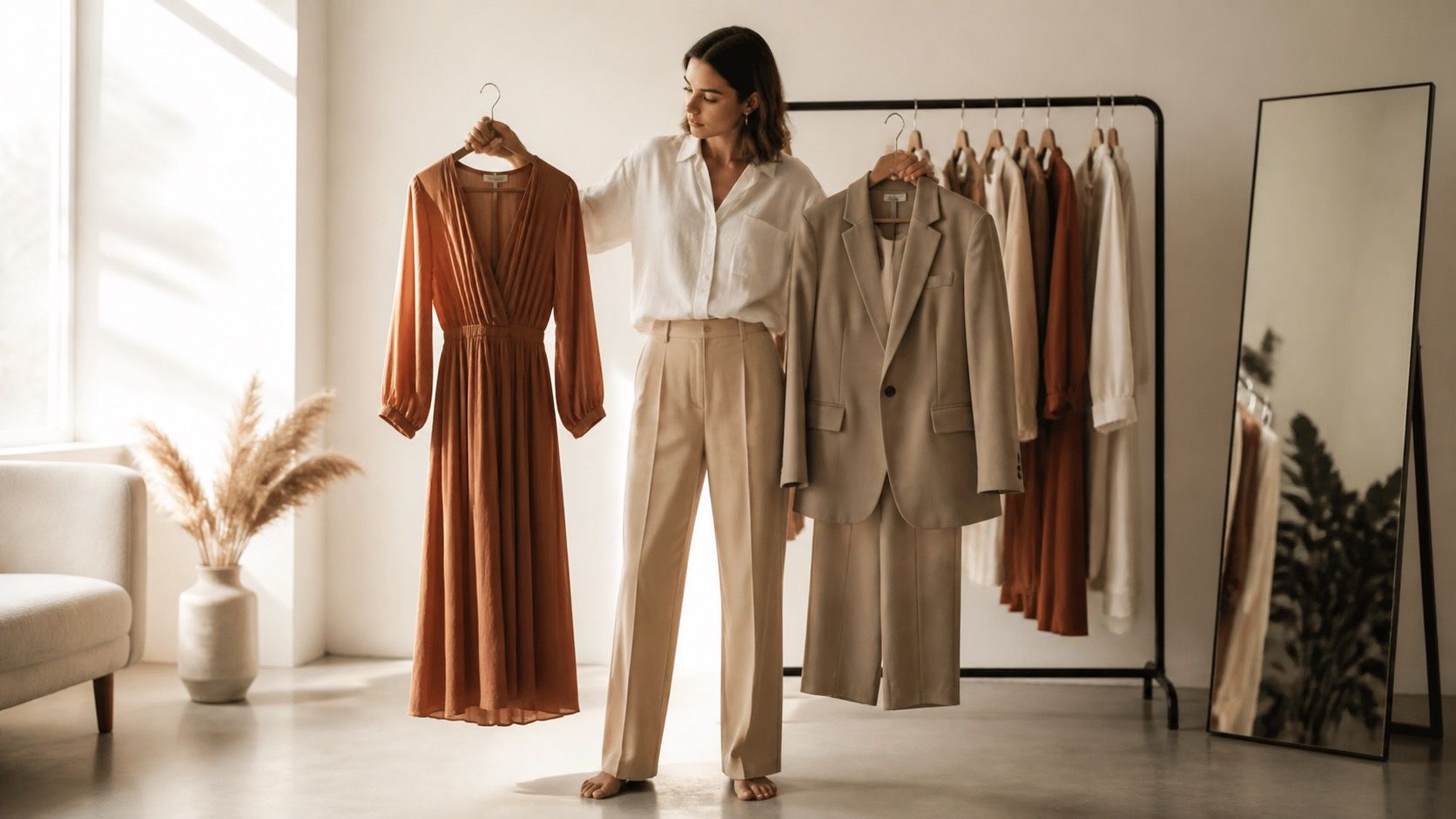
Instead of replacing a wardrobe after reading about Kibbe body types, make a small rack of comparison outfits. Keep the base layer the same and change one variable at a time: a cropped versus long jacket, stiff cotton versus fluid viscose, a narrow belt versus no belt, a small collar versus an open neckline. Take photos on different days, because mood and posture can influence a first impression.
Write down reactions in plain language. "My shoulders looked crowded" is more useful than "This is wrong for my type." "The long cardigan made the outfit feel calmer" is a real clue. Pay attention to comfort too. Clothes that technically follow a recommendation but make you self-conscious will rarely become favorites.
Personal expression belongs in the experiment. A person who likes black, denim, vintage jewelry, bright lipstick, or sneakers does not lose those preferences after choosing an image identity. The system can help choose the cut, scale, and placement of those choices. It should not turn personal taste into a narrow uniform.
Keep the system from becoming a rulebook
The best use of a style system is selective. It can explain why certain proportions consistently work and give a shortcut when shopping, but it cannot account for climate, work dress codes, disability, fabric sensitivity, budget, or a sudden change in taste. Those factors deserve just as much weight when deciding what to wear.
If a recommendation feels too strict, translate it into a question. Rather than "I cannot wear cropped jackets," ask whether this particular cropped jacket interrupts the line, whether a higher trouser rise changes the result, and whether a different fabric would help. A rule becomes useful only when it can survive a real wardrobe.
A clear Kibbe test is therefore not a quiz result. It is the accumulation of observations: which shapes make you stand taller, which details feel proportionate, and which clothes let your face and presence register before the outfit does. Keep the label provisional if needed. The clothes are the evidence.
It helps to leave room for ordinary contradictions. You may prefer a compact jacket for work yet look best in a longer coat outdoors; you may enjoy a loose weekend shirt even though it is not the clearest example of your line. Context changes the job an outfit has to do. Use the system when it gives a useful explanation, then set it aside when comfort, weather, or your own taste makes another choice more sensible. A productive Kibbe notebook contains photos and observations, not a list of bans. Over time, the useful patterns become obvious: which necklines make you stop tugging at the collar, which bag sizes feel proportionate, and which silhouettes receive compliments because you seem relaxed rather than because they fit an internet category.