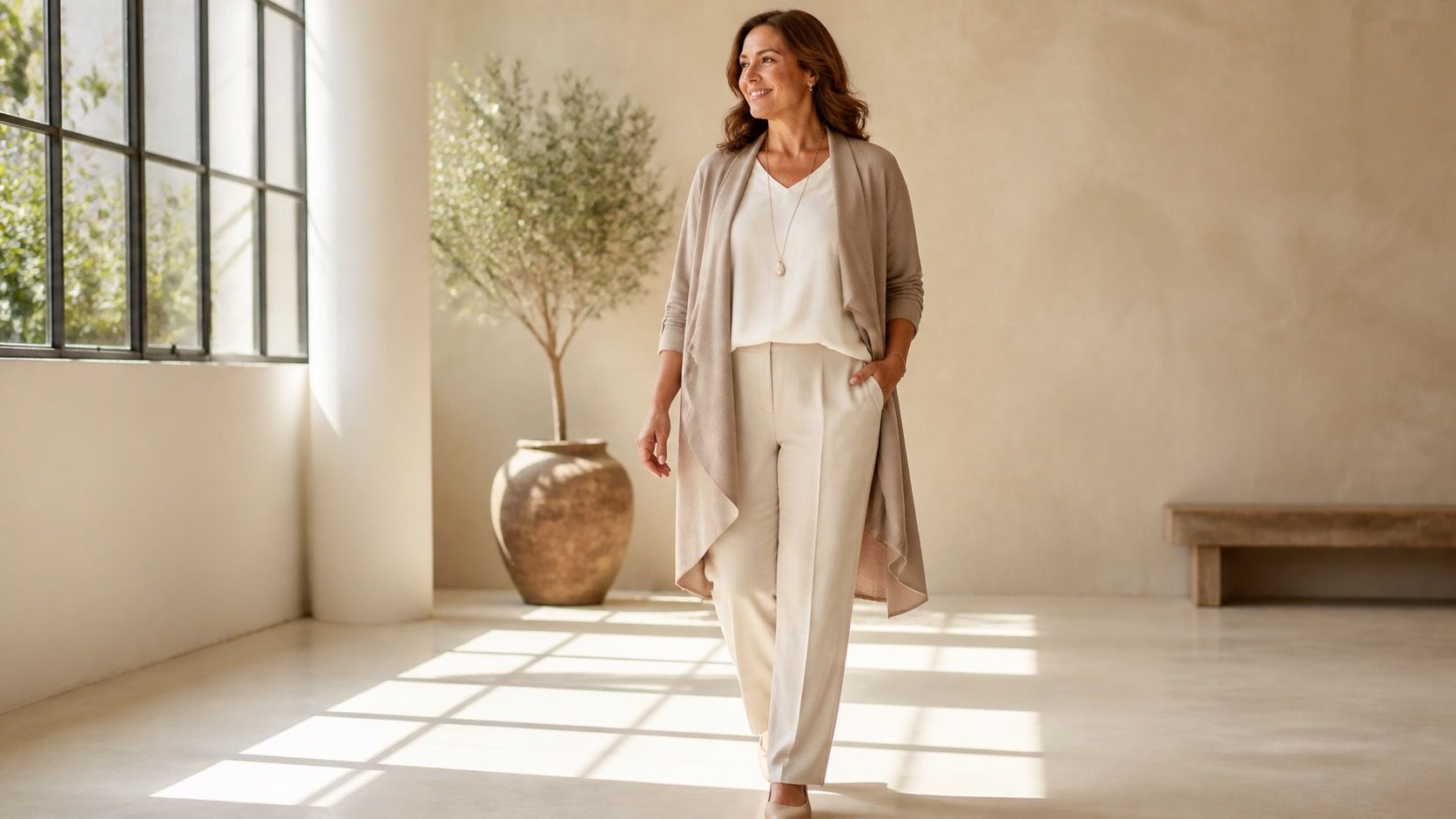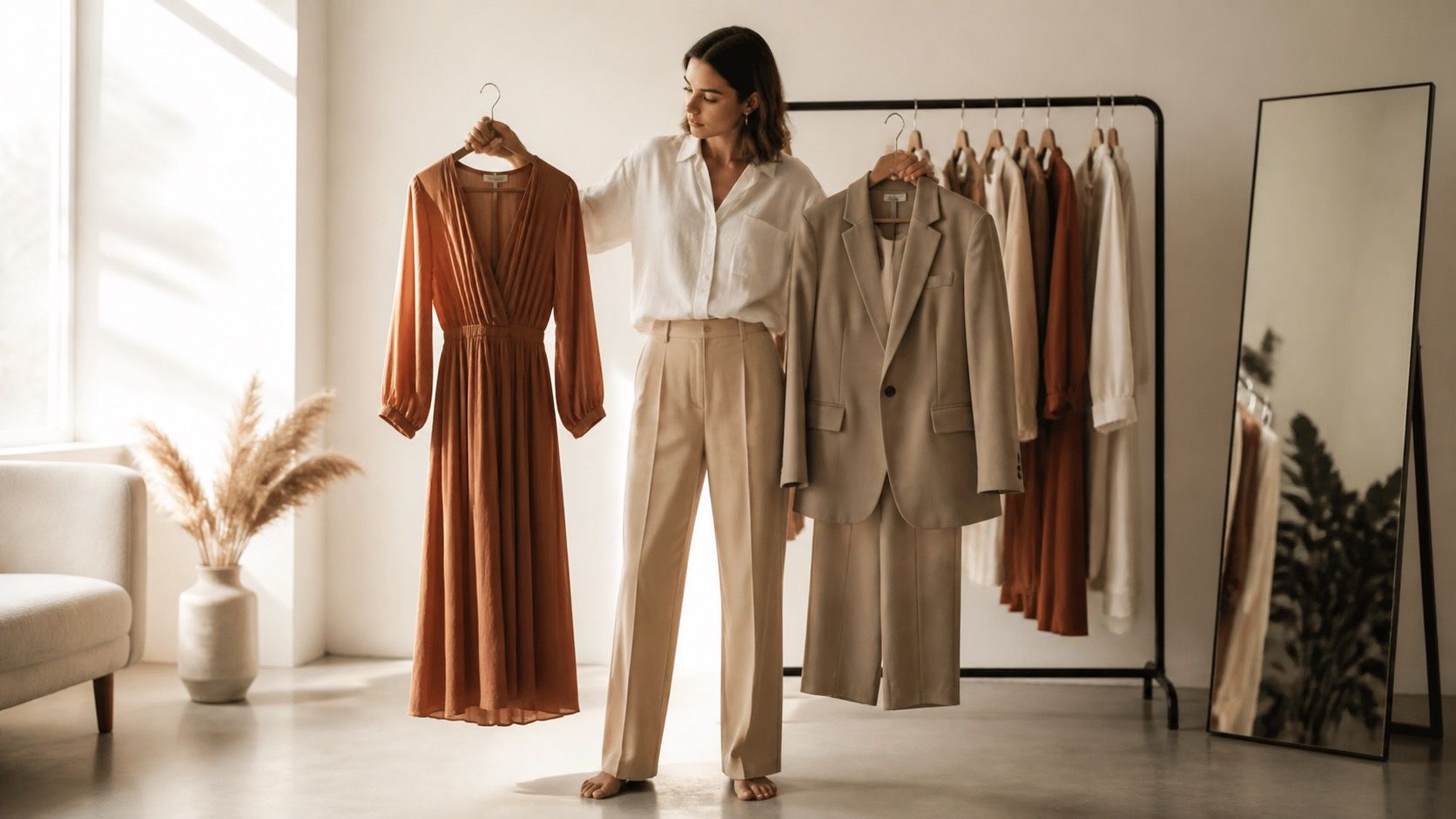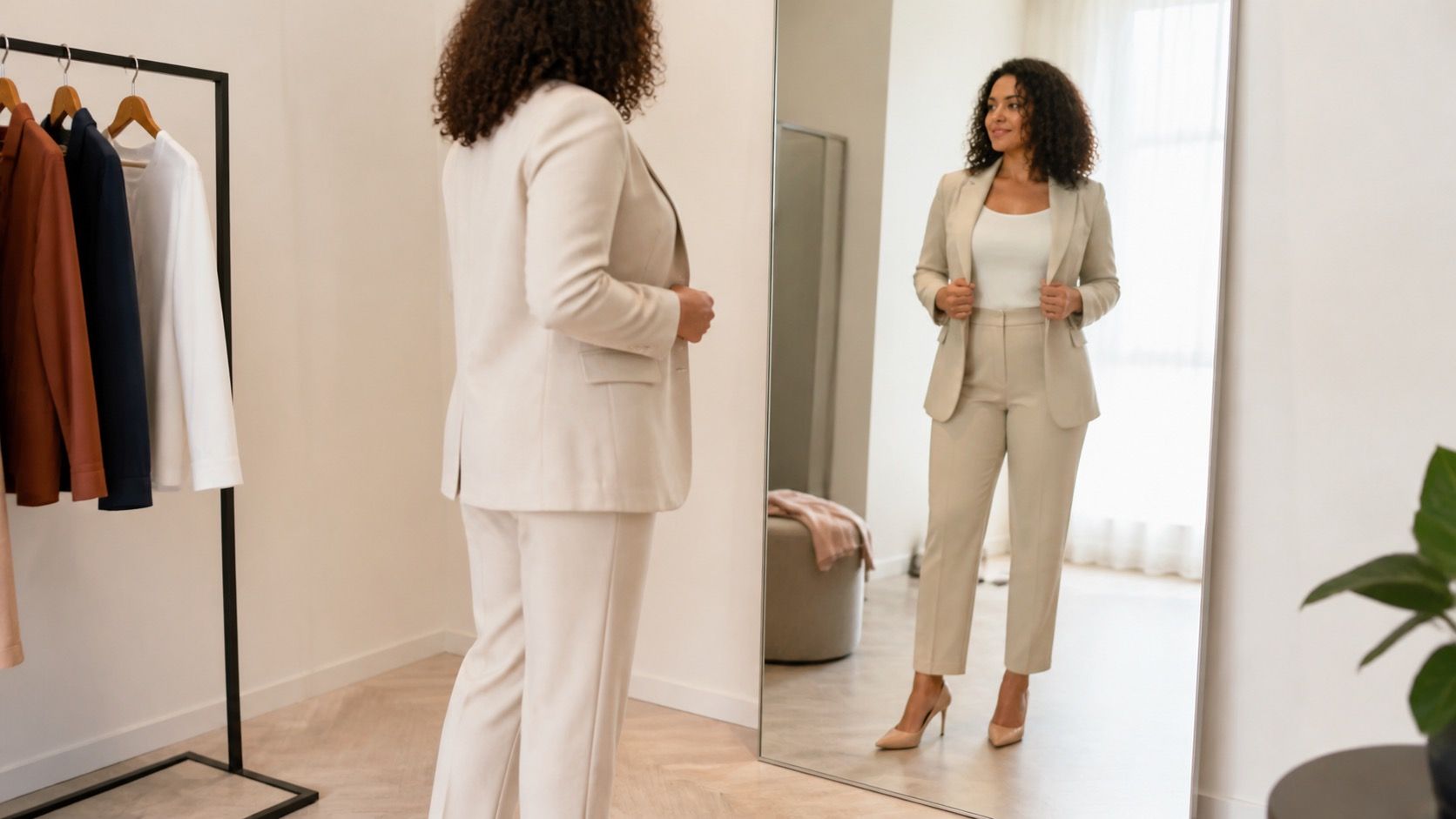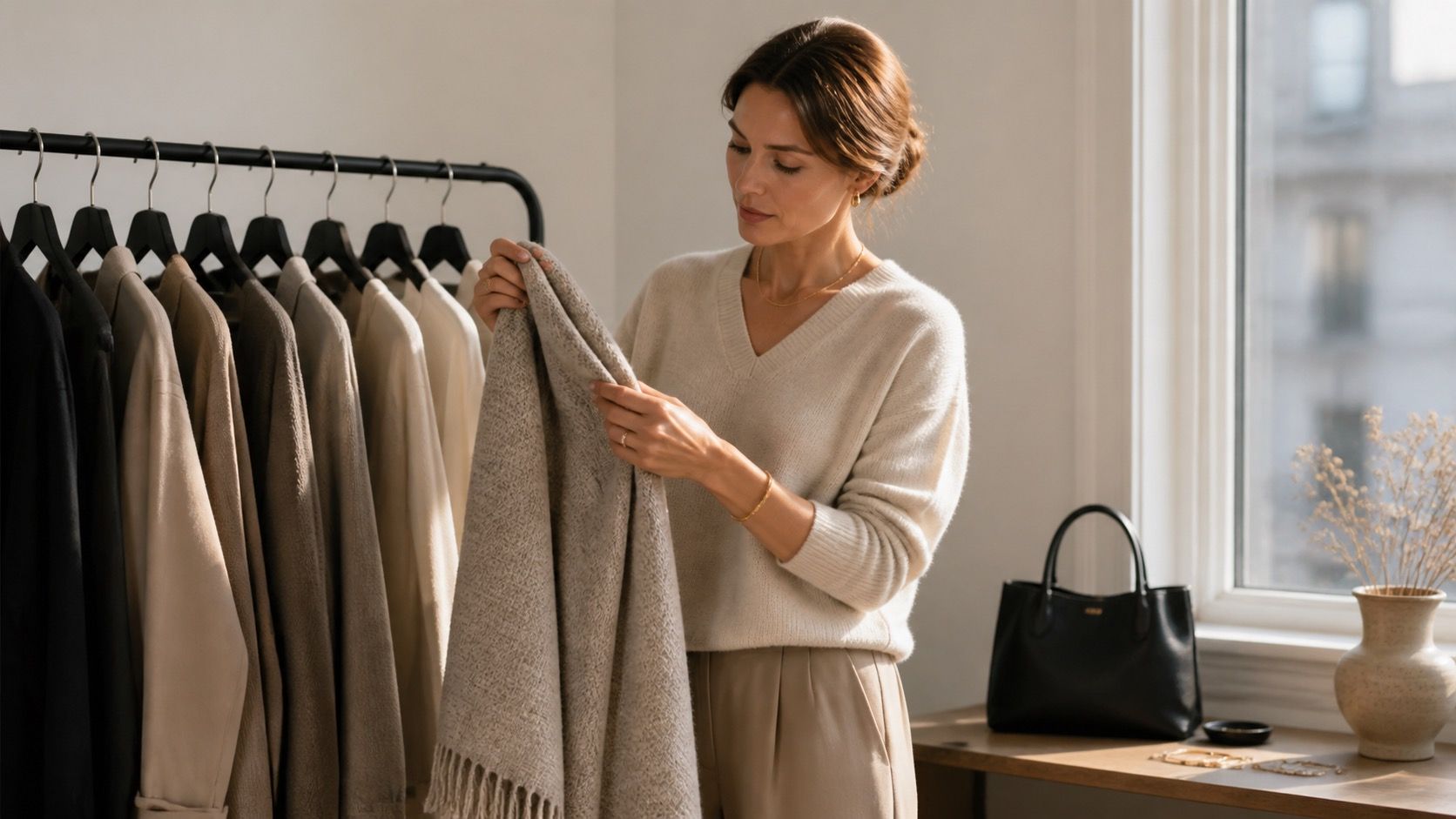
Style essences are most helpful when they take pressure off a single body-type label. They describe visual qualities: the effect of sharpness, ease, symmetry, youthfulness, softness, or otherworldly lightness. You do not need to prove that you belong to one category. The useful question is simpler: which details make an outfit feel recognizably like you, and which make it look borrowed?
Use body shape and essence for different decisions
Body shape and fit answer physical questions. Does this waistband sit comfortably? Does this jacket have enough room through the shoulder? Does the length interrupt your proportions? A style essence answers a visual question: once the clothes fit, what kind of line, texture, and finishing detail makes the result feel convincing? Mixing the two is a common reason someone buys “their type” of garment and still feels unlike themselves in it.
Know the seven commonly discussed essences without treating them as uniforms
The Kitchener essences are usually described as Dramatic, Natural, Classic, Gamine, Romantic, Ingenue, and Ethereal. Dramatic often benefits from clean contrast, elongated shapes, and a more defined edge. Natural tends to suit visible texture, a relaxed scale, and an unforced finish. Classic relies on balance, moderate detail, and polish. Gamine introduces compact contrast, crispness, and playful separation between elements.
Romantic emphasizes softness, roundness, and sensual detail. Ingenue is lighter, smaller in scale, and often more delicate or youthful in its treatment of trims and color. Ethereal uses length, translucency, diffusion, and an airy quality that can feel quiet rather than ornate. These are descriptions of visual impression, not personality tests. A person can be serious, athletic, shy, or practical and still enjoy a Romantic neckline or an Ethereal fabric.
It is also normal to see more than one quality. Most useful personal style essence combinations contain two or three signals rather than a perfectly pure category. A person may prefer Classic proportions with Natural texture, or a Gamine cropped jacket with Romantic jewellery. The purpose of the names is to give you a vocabulary for comparing effects, not to turn every shopping decision into a classification exercise.
Change detail before you change your whole wardrobe
Essence often shows up most clearly in detail scale. Imagine the same dark trousers and fine knit. A Dramatic-leaning version might use a long pendant, a pointed shoe, and strong contrast. A Natural-leaning version might add suede, a textured scarf, and a relaxed cuff. A Classic version might keep the shoe smooth, the bag structured, and the jewellery moderate. The core outfit is unchanged, but the viewer reads three different visual messages.
Fabric is another efficient test. Crisp cotton, dense wool, smooth silk, brushed knits, worn leather, sheer layers, and nubby linen do not merely have different price points; they create different levels of visual noise and softness. If you repeatedly buy items because the colour is right but never wear them, look at the surface. A highly polished satin blouse may feel too formal on someone who needs texture. A rough overshirt may feel too casual on someone whose features and preferences respond to clean refinement.
Accessories are useful because they are reversible. Before replacing dresses or coats, test earrings, bag shape, shoe toe shape, belt width, and scarf texture. Keep the rest of the outfit stable and take a quick photo in daylight. If one adjustment makes your face look clearer and the outfit look less effortful, you have found a clue. If it only makes the look more themed, the detail may be louder than your natural scale.
| Essence quality | Useful first experiment | Watch for |
|---|---|---|
| Dramatic | A sharper shoe or clearer contrast | Too many severe pieces competing at once |
| Natural | Textured fabric and relaxed construction | So much volume that the person disappears |
| Classic | Balanced scale and a clean finish | Over-editing until the outfit becomes bland |
| Gamine | Compact contrast or cropped proportion | Random novelty details without structure |
| Romantic, Ingenue, Ethereal | Softness, delicacy, or light layers in one place | Turning every item into decoration |
Combine essences by giving each one a job
A mixed essence wardrobe becomes easier when each quality has a role. Let one guide the silhouette, one guide fabric, and one guide finishing details. For example, someone with Classic and Natural preferences might choose a balanced blazer, soft wool trousers, and a textured leather bag. Someone drawn to Romantic and Gamine elements might wear a close-fitting cardigan with compact contrast buttons and a small curved bag. The outfit has more than one influence, but it still has a clear hierarchy.
Problems usually begin when every essence is asked to speak at full volume. A long Ethereal skirt, sharp Dramatic boot, oversized Natural jacket, Gamine graphic top, and ornate Romantic jewellery can each be interesting, yet together they read as five separate decisions. Try a two-to-one ratio instead: two elements from the quality you trust most, one accent from another. This keeps experimentation visible without asking strangers to decode your entire style research process.
Season and context matter too. An office with a conservative dress code may leave less room for an obvious Gamine contrast, but it can still accommodate a cropped cardigan, a patterned sock, or a compact watch. A weekend outfit can carry more Natural texture, while an evening look may give Romantic or Ethereal details more room. The essence does not disappear when the setting changes; it becomes a quieter choice of finish.
Test an essence without making a permanent decision
Use a small, repeatable test rather than a dramatic wardrobe purge. Choose one base outfit: jeans or trousers, a simple top, and the jacket you wear most. Make three versions over three days, each led by a different visual quality. Keep a note on the practical experience as well as the photo: Did you adjust the garment all day? Did the bag hold what you needed? Did the look feel appropriate at work, at lunch, and in a mirror at the end of the day?
Look for patterns, not instant certainty. You may find that a Natural fabric feels right but an oversized fit does not, or that Romantic earrings work while a fully ruffled blouse feels unlike you. This is useful information, not a failed category. Personal style essence is built through these smaller distinctions: texture versus volume, delicacy versus sweetness, sharpness versus severity.
Keep the system useful when your preferences change
Essences should make dressing more flexible, not more anxious. Your colouring, job, climate, budget, and appetite for attention all affect which recommendations are practical. A person who enjoys Ethereal lightness may express it with a semi-sheer sleeve or a long pendant rather than buying pale floor-length dresses. Someone with a Dramatic edge may use a dark monochrome outfit and one angular cuff instead of wearing extreme shoulder pads.
Return to the clothes you genuinely reach for. Notice their shared properties: perhaps they have soft movement, compact contrast, neat symmetry, substantial texture, or a little ornament near the face. Those repetitions are more valuable than a definitive label. The best use of style essences is to make that instinct visible, so future purchases have a better chance of joining the clothes you already live in.